



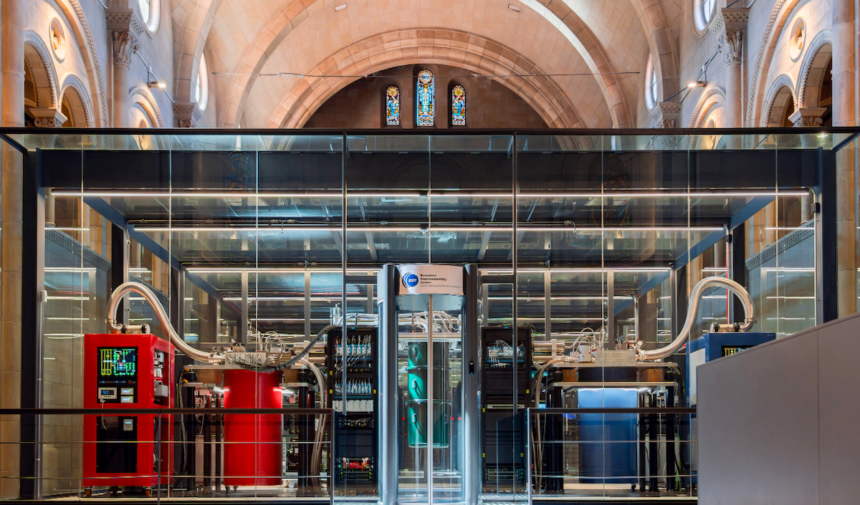
The new analog quantum computer built by Qilimanjaro Quantum Tech has been inaugurated at the Barcelona Supercomputing Center (BSC-CNS), home to MareNostrum 5, one of the most powerful supercomputers in Europe.
The deployment expands BSC’s quantum infrastructure, complementing the digital quantum system previously installed by Qilimanjaro and GMV in 2025 as part of Spain’s national quantum programme, Quantum Spain.

Together,these technologies form part of MareNostrum-Ona, BSC’s integrated quantum infrastructure combining analog quantum computing, digital quantum computing, and classical supercomputing within a unified hybrid environment.
This inauguration celebrates the first milestone of the EuroQCS-Spain contract, a project amounting to a total of €8.5 million and co-financed by the EuroHPC Joint Undertaking, the European Union’s flagship initiative to build world-class supercomputing and quantum infrastructure across Europe, and the Spanish SEDIA (the State Secretariat for Digitization and Artificial Intelligence).
Under the contract, Qilimanjaro as full-stack quantum providerand Do IT Now as HPC-QC integratorare delivering three generations of Adiabatic Quantum Processing Units (AQPUs), beginning with a 10 analog qubit system.

“With this installation, BSC becomes one of the few places in the world where analog quantum computing, digital quantum computing, and classical supercomputing operate together as a single resource, and we believe that is exactly the environment the field needs at this stage to move from promise to practical contribution,” said Marta P. Estarellas, CEO of Qilimanjaro Quantum Tech.
Qilimanjaro’s analog system is particularly well-suited for complex optimization problems such as logistics, energy networks, and financial modeling, as well as quantum simulation of molecules and materials for chemistry and physics modeling. The platform also opens new possibilities for the study of quantum enhanced AI workloads.
These capabilities complement those of the digital quantum systems already available at BSC, giving researchers and companies a broader computational unified toolkit.
The analog system is error-resilient by design, reducing the dependency on full error correction and allowing organizations to begin exploring applied quantum computing without waiting for fully fault-tolerant systems.
The new system will be accessible through EuroHPC and the Spanish Supercomputing Network (RES) access calls, enabling the European research and industrial community.
The EuroQCS-Spain contract includes training and ongoing technical support for the BSC team, with two further AQPU generations scheduled for delivery in 2026 and 2027. Each generation will progressively expand the capabilities available to the research community, supporting a growing range of applications across pharmaceuticals, materials science, logistics, finance, and artificial intelligence.
The project is part of a broader effort to strengthen Europe’s competitiveness in quantum technology and positions Barcelona as a global hub where analog quantum computing, digital quantum computing, and classical supercomputing work together to address complex scientific and industrial challenges.