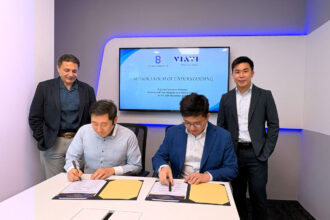




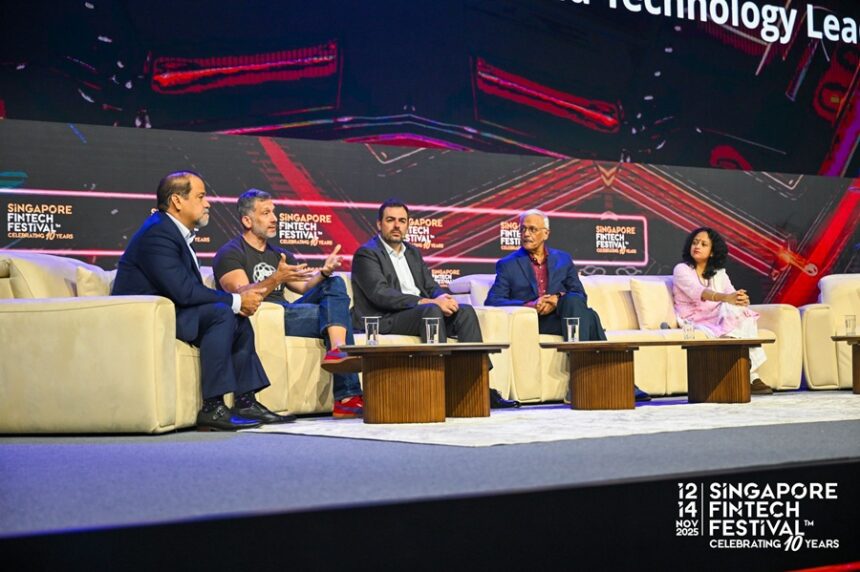
The Singapore Fintech Festival 2025 declared quantum computing and allied technologies a major theme of the event. Focusing on “quantum-resilient finance,” the event sought to bring quantum to the broader fintech audience. The panel “Quantum Frontiers: Insights from Research, Business, and Technology Leaders,” in particular, provided a succinct overview of quantum technology and how it will change the IT industry, with a focus on cybersecurity.
The panel began with a summary of the three main types of quantum technologies — quantum sensing, quantum communications, and quantum computing.
Explained Ray Harishankar, IBM Fellow & Vice President at IBM, “Quantum sensing is about measuring the physical quantities or values of certain things based on changes in these quantum states. Let me give you an example: time, acceleration, and gravity are some things that you can measure based on the changes in the quantum state, to a degree of accuracy that is currently not possible. You can apply this in navigation, medical imaging, atomic clocks, and a number of areas where such precision is needed. Quantum communication, meanwhile, is about communicating information from point A to point B using quantum mechanical principles in a phenomenally secure manner.”
Continued Harishankar, “And the third field, quantum computing – computation and information processing – is what you apply these quantum capabilities for. You have what is called a qubit, which is a quantum counterpart to a classical bit. And we measure and operate in terms of qubits, and solve problems that are somewhat intractable and cannot be solved within the classical space, or we solve them better.”
A real-world application of quantum computing
Recently, HSBC made headlines when it announced that it had achieved an improvement of up to 34% in algorithmic trading by leveraging quantum computing.
Dr. Philip Intallura, Head of Quantum Technologies at HSBC, explained that HSBC used a combination of machine learning and quantum computing.
“Algorithmic trading is where we use computer programs to automatically buy and sell financial instruments. The way this works is, we will receive requests for quotes from clients, who may say they want to buy a million dollars’ worth of bonds. We need to issue a price for that. But while we’re deciding what price to issue, that client is going to other financial institutions with the same request, and we don’t see any of it, so it’s kind of like a blind auction process. And so we use models to help us predict the price we need to go back with, but it’s an intricate problem. If you price too aggressively, it’s at the cost of profitability, but if you price too conservatively, you’re not going to win the bid,” he said.
He continued, “Today, we use machine learning models to help us find that price point. What we did with quantum computing was use it for a very particular part of that process, which is the characteristics of the bond that train the models. We converted it from the classical space to the quantum computational space, and it allowed us to find more complex patterns in that data to more effectively train these machine learning models. What made this, I think, quite a unique demonstration, was that it was using a real quantum computer for a real business problem at a real production scale. And that’s the first time we’ve really seen that.”
Cybersecurity, Post-Quantum Cryptography (PQC), and crypto agility
While quantum computing promises significant computational advantages, these same advantages also pose a threat to current security and blockchain frameworks, for example by breaking RSA encryption.
Explained Harishankar, “There is an intractable set of problems that quantum solves that classical does not. One of them is factoring numbers. That particular factorization [i.e., RSA] was used as an algorithm because there is no solution on classical computers to solve it. But Peter Shor, in 1994 – when he didn’t even have a quantum computer on hand – came up with an algorithm that could solve factorization. Long story short, with a sufficiently capable quantum computer called a cryptographically relevant quantum computer, one can break encryption and look at any information that you’re sending. So that is the risk that quantum poses.”
However, Harishankar pointed out, there are already Post-Quantum Cryptography (PQC) algorithms available, four of which have been selected by the US National Institute of Standards and Technology (NIST). These algorithms are designed for classical computers and cannot be decrypted using quantum computing, but new software will be required to replace existing algorithms with post-quantum ones. The ability to do so quickly and easily, he explained, is what is known as crypto-agility.
“With crypto agility, if more changes are needed in the future, you do not have to make significant changes to your system. You implement crypto agility so that you can switch from one algorithm to the other in the future, not just because the algorithms are going to be broken, but because human ingenuity may come up with better algorithms that you want to take advantage of. How do you modify your systems and make them foolproof or quantum-safe in such a way that such future changes are relatively easier to implement?”
Quantum Key Distribution (QKD)
According to Prof. Urbasi Sinha, Professor at the Raman Research Institute, India and the University of Calgary, Canada, all PQC algorithms are software-dependent and might one day be susceptible to being compromised by quantum computers. To be truly secure, she argued, cryptography will need to leverage the properties of quantum mechanics itself, through a method known as Quantum Key Distribution (QKD).
She said, “We need a hardware solution parallel to the software solution, and this hardware solution will be based on laws of quantum mechanics. That is QKD.”
Sinha explained, “If I were to communicate secretly, what would I do? I would encrypt my message using a key, which is a string of bits. The recipient would have a copy of the key and use it to decrypt. But somebody who doesn’t have the key won’t be able to know the big secret that I’m sending. That is the idea of key distribution. The most important thing here is the distribution of the key, which has to be done in a secure way; otherwise we stand to be compromised. And so that is what we are using the laws of quantum mechanics to secure.”
The panelists agreed that organizations should prepare themselves for the future by exploring both PQC and QKD.
Dr. Intallura described how HSBC is doing this: “Cryptography is so important. It’s going to impact everyone. It’s particularly important for financial services, and so we’ve been doing a lot of work around PQC and QKD. At this juncture, I wouldn’t write off any type of technology that can help us protect our customers, data and payments.”
“Just to give you a few flavors of what we’ve done over the last couple of years, we’ve applied PQC to move gold tokens from one Distributed Ledger Technology to another. So gold tokenization is a service we offer in a couple of our markets.”
“Another example is where we’ve applied quantum keys generated by QKD. We have this installed in our head office and a data center in London to secure the FX rate. And most recently, we’ve done some really great experiments and trials in Singapore with other banks also testing QKD. We’re very much moving now into turning the R&D into practical, implementable solutions to mitigate against the threats that have been outlined.”
Where is quantum computing today?
Although quantum computing is much talked about today, there is currently no commercially viable quantum computer able to outperform classical computers in a general and consistent manner, nor one powerful enough to pose a threat to security.
Said Prof. Michael Biercuk, Founder & Chief Executive Officer at Q-CTRL, “This is an emerging technology. Quantum computers are real. You can log on to these machines and you can run workloads on them. It is, however, still an early stage. That means that the machines are small, and there’s a technical challenge that they all face, which is that they are faulty. They suffer from a lot of failures. Your laptop could run for about a billion years and never suffer a hardware error. A quantum computer lasts about a millisecond. That’s roughly a community average, and there’s a huge difference between a billion years and a millisecond. Right now, quantum computers are not better than the best competitive alternative, but the advances in hardware and software are pushing us to the threshold where the machines are just now becoming good enough to enable the kinds of applications you heard about.”
Preparing IT professionals for the quantum age
Being an emerging technology, quantum computing is currently confined to academia and its spin-off companies. According to Prof Biercuk, the need for talent is becoming pressing.
He said, “We realized at Q-CTRL that we actually had a huge number of people reaching out to us who were simply not ready to use our technical tools. And instead of sending them away or doing consulting, we focused on building a solution called Black Opal. It’s like Duolingo for quantum computing. The idea is we don’t just need more people with PhDs in quantum physics. Of course, we certainly want continued investment in the people who are going to drive the creation of this technology long term, but we need 10, 100, or maybe even 1,000 times more people who are conversant and able to leverage and apply this technology than people whose role is to build it. It’s much the same way all of us use computers, but not everybody can program at the kernel level or even write in Python. We need people able to use and understand how quantum computers will impact their businesses,” he concluded.