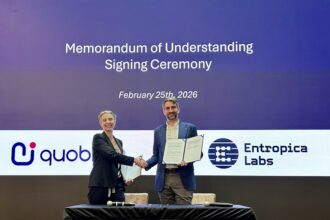





QUDORA, which is building full-stack trapped ion quantum computers, and ParityQC, which is working on quantum architecture, have announced a strategic partnership to optimize quantum algorithm performance on trapped-ion hardware platforms.
The partnership will combine QUDORA’s Near-Field Quantum Control (NFQC) technology with ParityQC’s architecture framework. ParityQC will work with QUDORA’s engineering teams to tailor and optimize its algorithms for QUDORA’s hardware platform.
The Optimization Challenge
Quantum computers deliver practical value only when algorithms are aligned with the physical characteristics of the underlying hardware. Without hardware-specific optimization, algorithms typically require more qubits, deeper circuits, and longer coherence times than needed.
ParityQC’s Parity Twine technology addresses this challenge by restructuring algorithms to match the topology and operational constraints of specific quantum processors. Applied to QUDORA’s trapped-ion systems, this approach reduces gate counts and circuit depth, directly improving computational efficiency. Fewer operations mean less accumulated error and better results with existing hardware.
“Efficient use of hardware resources is essential for delivering practical quantum computing,” said Dr. Daniel Borcherding, Head of Quantum Software at QUDORA. “ParityQC’s architecture-driven approach allows us to improve algorithm performance on our systems without increasing hardware complexity. This supports faster progress toward customer-relevant quantum applications.”
“We’ve shown that Parity Twine enhances the performance of currently existing quantum hardware and allows to implement corner-stone algorithms in the most efficient way. Combining our approach with QUDORA’s vast experience in building trapped-ion quantum hardware will fast-track the development towards utility scale quantum devices,“ said Wolfgang Lechner and Magdalena Hauser, Co-CEOs ParityQC.
Quantum Computing Made in Europe
The partnership is rooted in a shared European quantum technology ecosystem. QUDORA operates from Germany, while ParityQC is based in Austria with subsidiaries in Germany, France and UK. Both companies are engaged with partners such as the German Aerospace Center (DLR) and NXP Semiconductors, creating a strong foundation for coordinated technical development.