



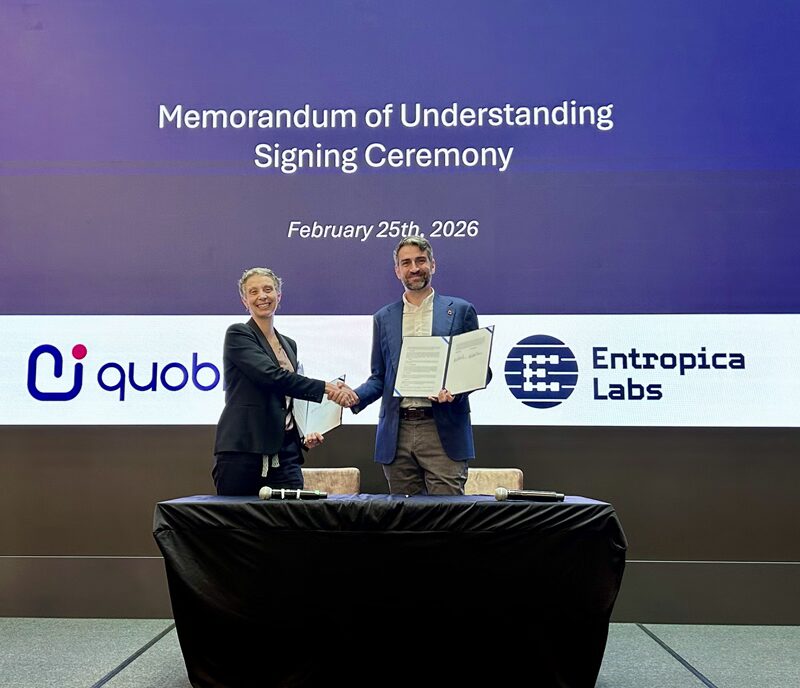
Quobly, a French company in silicon-based quantum computing, and Entropica Labs, a Singapore-based quantum software company, today announced the signing of a strategic Memorandum of Understanding (MoU) to collaborate on the development of fault-tolerant quantum computing technologies.
The MoU was signed in Singapore by Maud Vinet, CEO of Quobly, and Tommaso Demarie, CEO of Entropica Labs, in the presence of representatives from the Singaporean and French innovation ecosystems.
This agreement marks a new milestone in Quobly’s expansion in Singapore, following the company’s incorporation announced in October 2025 during the Singapore Week of Innovation and Technology (SWITCH), and reinforces its strategy to develop Singapore as its regional hub for partnerships and deployment in Asia, while its core research, technology development, and industrial activities continue to be led from France and Europe.
This collaboration brings together Quobly’s silicon-based quantum processor architecture and Entropica Labs’ fault-tolerant quantum software stack from the early stages of system design; Entropica Labs’ technology will serve as a foundational software layer for scalable silicon quantum systems and enable hardware and error-correction software to be developed in close coordination for real-world applications.
Developing fault-tolerant quantum software tailored to silicon quantum processors
This MoU establishes a framework for the joint development of fault-tolerant quantum software capabilities tailored to Quobly’s silicon quantum processors.
In particular, the collaboration will focus on developing advanced compiler and optimisation technologies for fault-tolerant quantum error correction (FTQEC), adapted to Quobly’s silicon-based quantum architecture, and supporting the operational readiness of future quantum systems in the Asia-Pacific region.
By combining Entropica Labs’ quantum software, compiler, and optimisation technologies with Quobly’s semiconductor quantum hardware, the collaboration enables tighter software–hardware co-design. This co-design approach is essential for scaling silicon quantum processors beyond laboratory prototypes toward fault-tolerant, industrial-grade systems ready for real-world applications.
“Partnering with Entropica Labs, a Singapore-based quantum software company, strengthens our ability to build scalable quantum systems by combining silicon hardware with fault-tolerant software,” said Maud Vinet, CEO of Quobly. “Singapore plays a key role in our international strategy, and this agreement marks an important step in establishing our long-term presence in the region.”
“As silicon quantum processors scale, the central challenge shifts from qubit physics to system-level fault tolerance. Unlocking their full potential requires tightly integrated error-correction and orchestration software. Quobly’s approach to silicon quantum computing represents one of the most promising paths toward scalable quantum systems. We look forward to working closely with Quobly to co-design the fault-tolerant infrastructure layer that turns scalable qubits into quantum computers, and bring silicon quantum systems to operational maturity”, said Tommaso Demarie, CEO of Entropica Labs.
Strengthening Singapore’s role and contributing to the global quantum ecosystem
This collaboration supports Quobly’s broader international development strategy while strengthening Singapore’s position as a regional hub for quantum innovation and deployment in Asia. It also establishes a framework for ongoing technical collaboration between Quobly and Entropica Labs as both companies advance their respective roadmaps. More broadly, the agreement highlights the importance of cross-border cooperation between leading quantum hubs in Europe and Asia and reflects a shared commitment to accelerating the transition from experimental quantum devices to scalable, fault-tolerant quantum systems ready for real-world applications.