




Rigetti Computing was awarded a three-year, $5.8 million contract from the US Air Force Research Laboratory (AFRL) to advance superconducting quantum networking.
For this project, Rigetti will be collaborating with QphoX, a Dutch quantum technology startup developing frequency conversion systems for quantum applications.
Much like classical HPC, quantum networks could provide a path for scaling to larger, more powerful quantum computing systems by networking smaller systems together to solve problems by using multiple quantum processors. It could also unlock the ability to transmit information between quantum nodes in different geographical regions.
A key challenge to networking superconducting quantum computers is the need to convert the microwave signals, which are used to control superconducting qubits, to optical photons that can travel along those fibers. This project aims to deliver systems providing entanglement between superconducting qubits and optical photons, the essential building block of quantum networking.
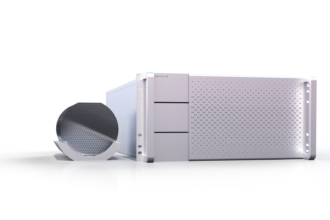
Building on Rigetti and QphoX’s demonstration of qubit-transducer systems working together to perform optical single-shot qubit readout, the team plans to combine superconducting microwave qubits developed by Rigetti with single-photon microwave-optical transducers developed by QphoX.
By transferring excitations from the qubit chip resonators to the transducers, the individual microwave photons will be converted to optical photons while still preserving their quantum character.
Subodh Kulkarni, CEO of Rigetti, said that the combination of Rigetti’s expertise in designing, fabricating, and operating superconducting qubits and QphoX’s transduction technology as well as AFRL’s expertise in hybrid networked quantum systems presents “an exciting opportunity” to advance superconducting quantum networking.
“Bringing our technology together with our partners directly into the hands of an end-user who develops quantum networks based on superconducting qubits linked with optical interconnects is a critical milestone for this field,” said Simon Groeblacher, CEO of QphoX.
Matt LaHaye, principal research physicist with AFRL, said AFRL is actively pursuing the development of heterogeneous quantum interconnects for integrating matter-based quantum technologies, including superconducting qubits, within their recently established telecom-based quantum local area networks (QLANs) in Rome, New York.
“Interconnects that link superconducting qubit processors with telecom QLANs will be a transformative step to investigations of entanglement distribution for fundamental research and capabilities for Air Force and DoD operations,” said LaHaye.