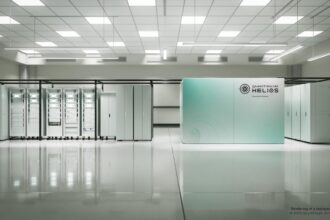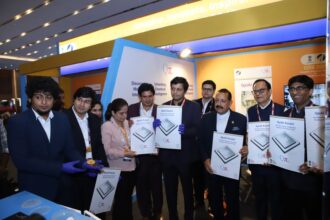




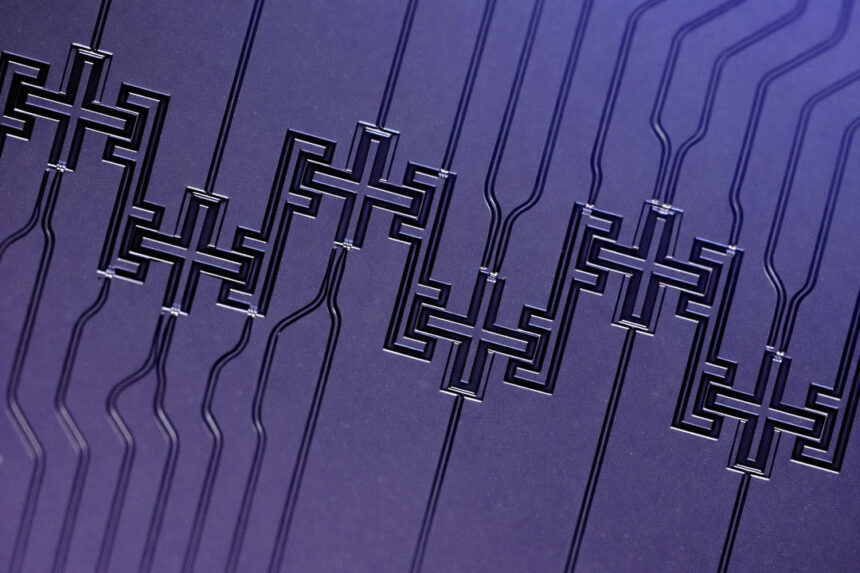
Taiwan’s Academia Sinica has announced the development of a 20-qubit superconducting quantum chip, designed and fabricated in-house, which has been successfully integrated into a full quantum computing system. The system is already open to domestic academic and research institutions for quantum simulation and related studies, and will eventually serve as a test platform for industrial users in hardware-software integration and algorithm development.
This is Academia Sinica’s second domestically designed and manufactured superconducting quantum computer, the first being a 5-qubit system completed in 2023. Following that, in June 2025, Academia Sinica successfully produced high-quality superconducting qubits on an 8-inch wafer platform. At the time, the institution also inaugurated Taiwan’s first quantum chip fabrication R&D platform and quantum computing test platform.
The current 20-qubit system was built with the help of the semiconductor industry in order to address the stringent demands in fabrication control and uniformity. For this, Academia Sinica leveraged semiconductor industry experience in large-chip manufacturing—both in equipment and process control— to pioneer research in quantum chip manufacturing and to build a quantum ecosystem.
Tackling Multi-Qubit Coupling Challenges and Expanding Computational Space
According to Distinguished Research Fellow ChiiDong Chen, Executive Officer of the Thematic Center for Quantum Computing and Executive Director of the Quantum Computing Thematic Center at the Research Center for Critical Issues, the newly announced 20-qubit system expands the computational variable space and demonstrates that Academia Sinica has mastered stable multi-qubit fabrication and qubit coupling, while also developing laser-trimming of qubit frequency and other key techniques. He added that the team continues to enhance chip-stacking methods to reduce crosstalk between qubits, while improving control and readout efficiency, thereby boosting overall computational performance.
530-Microsecond Coherence Time: A Foundation for High-Performance Computing
A major technical breakthrough was achieved in extending the qubit coherence time (T1) from the earlier 5-qubit system’s 15–30 microseconds (µs) to 530 microseconds, greatly improving quantum state stability and enabling longer durations of computation.
Assistant Research Fellow Chung-Ting Ke from the Research Center for Critical Issues explained that superconducting qubits are highly sensitive to electromagnetic disturbance. Beyond microwave control signals, any noise leaking into the packaging system affects performance. He lauded this new system as a landmark technical leap that marks a boost to world-class fabrication capabilities and provides a solid foundation for building high-performance quantum computers in the future.
This study is supported by Academia Sinica’s Grand Challenge Program and the National Science and Technology Council’s Quantum Technology Program, and is conducted in collaboration with universities including National Changhua University of Education, National Central University, and National Chung Hsing University to advance the development of quantum computing in Taiwan.
To promote international academic and industrial exchange, Academia Sinica will host the Superconducting Quantum Computing Workshop on February 4–6 of this year at its South Campus. Attendees will be able to test the 20-qubit superconducting quantum computing system on-site, showcasing Taiwan’s capabilities in quantum R&D and real-world implementation.