



As quantum companies begin to mature and commercialise, they are gradually shifting their focus towards scalable manufacturing. With this come operational and commercial issues: industrialization and standardization, working with customers, and information sharing versus Intellectual Property (IP) protection.
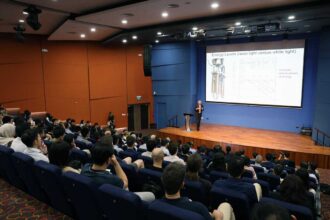
At the panel ‘Closing the Quantum Gap: Advancing Hardware, Industry, and Economic Growth’ held at the National Quantum Federated Foundry (NQFF) Day in Singapore, industry leaders from business (IQM, Quobly, SpeQtral) and government (Singapore’s Economic Development Board) discussed the manufacturing and supply chain requirements that must be resolved to achieve deployable products at scale.

Industrialization and the manufacturable quantum stack
Panelists emphasized that the transition from prototype to product requires explicit attention to manufacturability across multiple layers of the quantum stack, and described development workflows as comprising at least three components – (a) design for manufacturability, where quantum device designs take advantage of current manufacturing technologies; (b) the establishment of test and qualification regimes; and (c) supply chain integration, requiring standardized component interfaces to enable modular assembly and replacement while allowing multiple suppliers to deliver interoperable parts.
Lionel Lim, Vice President and Head, Technology Hardware & Equipment at the Singapore Economic Development Board (EDB) framed the problem as one of bridging a gap between technology roadmaps and their execution. He observed that companies “have been moving their quantum roadmaps, their technology road maps, very rapidly” and that this acceleration exposes “new circumstances, new situations and new problems” that must be resolved through supply chain and precision engineering capabilities.
One way to do this, he suggested, is to leverage existing manufacturing ecosystems in other industries and domains. He cited the example of Singapore, noting that a mature semiconductor industry and local capabilities in areas such as lasers, optics, and test and measurement equipment can be used to move quantum technologies forward.

Chune Yang Lum, Co-Founder & Chief Executive Officer at SpeQtral illustrated the scale implications for quantum networking.
“The quantum device that’s running either Quantum Key Distribution (QKD), or other forms of quantum networking, would benefit from a lot of the industrial processes. And for quantum networking and such environments, you are talking about the scale of classical networking – optical switches, encryptors, networking devices, which will go into hundreds of millions of individual units of devices.”
The importance of standardization
Panelists discussed how standardization and modularity are necessary engineering enablers for interoperability and customer clarity.
Juha Vartiainen, Co-Founder & Chief Global Affairs Officer at IQM, remarked that in addition to improving quality and lowering costs, clear standardization guidelines and outputs are necessary in order to satisfy customer requirements.
He said, “Standardization is important when we have more than one actor in the value chain. When you want to make sure that you serve the customer well, that the customers understand what they are buying, there should be standardization. It’s so important for the customers.”
He also pointed to the complexity of the supply chain, emphasizing that building a trusted international supply chain requires standardization and modularity.
“When we are building an international supply chain from trusted countries, there are inherently many, many suppliers – let’s say the decoders for quantum error correction, or cables and connectors. So when you start to trust your supplier network, then you need to have standards, and standardized product interfaces. You need to have a modular architecture. It’s the same for the software stack – you need compilers or other software components. And it needs to go through standardized interfaces so they’re interchangeable, and the customer can select what best matches their day to day requirements.”
How customer relationships drive innovation
The panelists positioned close customer relationships as key forces underpinning sustainable development, both in terms of commercial growth and of technological innovation.
According to Vartiainen, growth can only happen when a company is able to deliver products that genuinely meet customer needs and satisfaction; once a strong product–market fit is achieved and sales follow, funding becomes more accessible. This, he added, can then be used for R&D and to grow the company.
Maud Vinet, Chief Executive Officer & Co-Founder at Quobly, argued that quantum computing is still at an early stage, and a more nuanced approach must be taken with regards to customer relationships.
She said, “Who is actually making money today? We should not be mistaken about which stage quantum computing is at. We, as quantum computing companies, need to be very honest regarding the value that we deliver to the industry today. Today our customers are what we call early adopters, and this is more of a collaboration—we’re selling, but in a way where there is co-development, and where we improve the product thanks to their feedback. We co-develop algorithms, and we’re co-developing a lot of the components that are needed for our quantum computers.”
She added that there is a strong need to establish extensive collaboration across the various stages of hardware development—bringing together customers, quantum computing providers, and academic labs—so the field can progress more rapidly than it would through isolated efforts.
Lum added that to drive sustainable growth, there is a need for quantum technology companies to educate the end-user community.
He said, “Broadly speaking, to sustain the advancement, the technology has to get into the hands of the end users. And that takes a lot of education on the part of the providers and academics towards the broader industry. Largely across the board, in the industrial sectors, there’s still very little knowledge of what quantum tech is about.”
Transparency, IP and collaboration protocols
A recurring theme on the panel was the tension between scientific openness and commercial secrecy, and how businesses can balance the two.
Said Lum, “My perspective is a little bit philosophical. Science is open and technology is secretive. If you take that statement as true, then the secretive part of a technology… is typically a company’s secret sauce, trade secrets, or competitive advantage. This dichotomy, I think, is inherent in the socio-economic system that we’ve adopted.”
IQM’s approach is to publish scientific papers to help customers understand the technology better while at the same time protecting themselves with patents. The reason for this, said Vartiainen, is that customers “don’t want to have a black box, they want to understand. They want to have a system where they understand what it’s doing, how it’s working, and why it’s doing or behaving like it is.”
Reiterating that quantum computing is at an early stage, Vartiainen added, “We are patenting our core technologies. But with regards to our software stack, we are open-sourcing a selected part of that. We let business decide where the openness is bringing value—in this early stage, our customers are scientists who love to understand how the product is working. Maybe later on, there will be different kinds of customers, who don’t care as much”.
For Quobly, this tension is a familiar one, which they have resolved by formalizing the process of balancing openness and discretion, and sharing their knowledge on a strictly need-to-know basis.
Vinet explained, “We collaborate on a need-to-know basis, based on what is useful to the person that we’re working with. There are things that we need to exchange with the companies or the academics we’re working with—anything that is going to increase and maximize their impact. But they don’t necessarily need to know all the secrets, for instance, the process recipes that led to silicon, silicon oxide. For us, this is definitely a differentiating asset of the company.”
She then described the formal process of determining what can be shared. “What we’ve done in Quobly is to know what is a differentiating asset, and what’s needed in the collaboration with partners. We do an in-depth analysis, so that when we set up a new collaboration framework, we know what needs to be shared to maximize the impact of the two partners. And I think if we don’t do that, we’re going to either disclose too much information as a company, or we’re going to lose some opportunity in the market.”
Concluding the panel from a policy and economic development perspective, Lim emphasized the role of jurisdictional capabilities and IP regimes in enabling collaboration. He argued that locations with mature semiconductor ecosystems and strong IP protection can serve as platforms where different players converge to solve common problems. Lim said that Singapore promotes platforms that bring “different players here, bringing all the different problem statements to come together,” and he stressed that a robust IP regime is important to “drive open innovation, yet protect the capabilities of the companies.”