
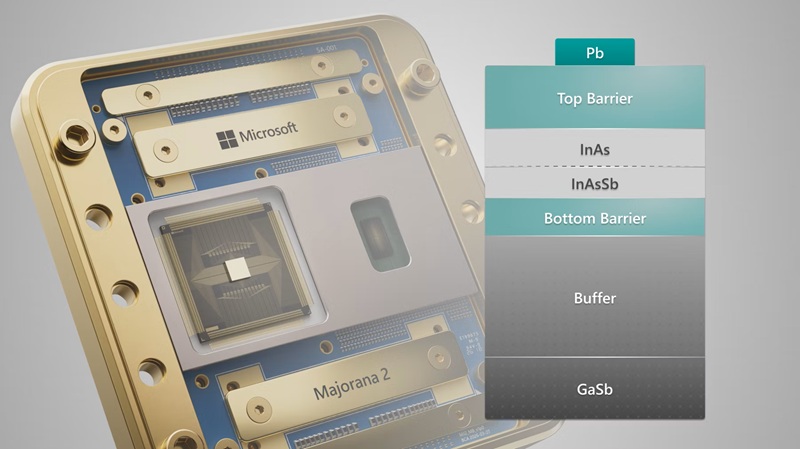
Microsoft has unveiled Majorana 2, its newest topological quantum chip featuring a next-generation materials stack and a claim that the qubits that are 1,000 times more reliable than their predecessors. With this, Microsoft expects to achieve a scalable quantum computer by 2029, cutting its original timeline in half.
The company says that Majorana 2 offers a mean qubit lifetime of 20 seconds, with some instances lasting as long as one minute. Microsoft also says that its chip is able to execute one microsecond operations, with a small qubit size of 1/100th of a millimeter.
“We need to make improvements each year that will get us closer to delivering a computer that we believe will have massive commercial and societal value,” said Chetan Nayak, Microsoft technical fellow. “We’ve got to keep marching to that roadmap to accomplish that, but where are we relative to last year? We’re 1,000 times better.”

In his Microsoft blog post, Nayak said the new chip was designed with the help of AI, and is made from a new material stack that replaces Majorana 1’s superconductor, aluminum, with lead, and also updates the semiconductor active region to a combination of indium arsenide and indium arsenide antimonide. This, he wrote, creates a stable topological phase and doubles the topological gap, which protects the topological qubits from environmental noise and errors, as compared to the previous chip.
In designing Majorana 2, Microsoft combined prior research with the company’s agentic AI tool Microsoft Discovery. One of the ways in which AI was helpful was to shorten the process of discovering the correct materials composition.
Said Zulfi Alam, corporate vice president for quantum at Microsoft, “Finding the exact recipe, the right amount to put to get the desired energy structure, requires a lot of experimentation in the old world order. In the new world order, through simulations, you can see where the highly probable target is. And then with that knowledge, you ideally only have to experiment once.”
According to Alam, AI was also useful in qubit measurement, by automatically and continuously running the process of determining qubit state and electron parity, and then building a 3D map of the conditions.
Read the paper here.