




On one of the world’s busiest data corridors, in January this year, Colt Technology Services and Ciena completed a Transatlantic trial intended to show that quantum-safe protection can be applied to live, high-capacity network traffic without sacrificing performance. The demonstration protected data travelling across 6,900 kilometres of Colt’s subsea and terrestrial network between New York and London, using Ciena’s WaveLogic 6 Extreme encryption solution to secure an 800Gb Ethernet service rate across the route. We interviewed Greg Collins, Vice President of Technology and Security at Colt Technology Services, and Prasanna Sundaram, Director of Architecture, Innovation and Testing at Colt Technology Services to find out more about the details of the trial.
The Transatlantic test
The companies described the trial as one of the fastest quantum-safe data transmissions demonstrated to date and the fastest across a Transatlantic route. In practical terms, the 800GbE service rate is designed for data-centre-scale volumes, allowing very large amounts of information to be moved across the Atlantic in seconds while remaining protected against threats associated with future quantum computing.
The urgency behind the work comes from the “harvest now, decrypt later” risk, where bad actors intercept and store encrypted data in transit, with the intention of decrypting it later if quantum computers become powerful enough to break traditional encryption methods. Colt notes that this could be possible as early as 2030. The same context is reflected in research cited by the company, which found that 69% of organisations believe quantum computing poses a real risk to current encryption, while 46% believe large portions of their data could be compromised.

How the quantum-safe layer works
For Colt and Ciena, the significance of the latest demonstration lies not only in the use of post-quantum technology, but in showing that it can operate over real production-style infrastructure at very high speed. The trial used Ciena’s WL6e 1.6T quantum-safe encryption solution on the Waveserver platform. The solution uses commercially approved, NIST-compliant post-quantum cryptography algorithms, including ML-KEM, the Module-Lattice-Based Key-Encapsulation Mechanism standardised by NIST as FIPS 203.
ML-KEM is used to support quantum-resistant key establishment, key exchange and authentication. The networking hardware, including optical transport systems and routers, then acts as the encryption platform that uses those PQC-derived keys to establish secure sessions and protect data in transit with established symmetric encryption algorithms such as AES-256. PQC helps secure the keys, while the network infrastructure applies those keys to encrypt and carry the data.
Three trials, several routes to security
The latest test was the third in a series of Colt quantum-safe transatlantic trials using different technology approaches. An earlier trial with Adtran, formerly ADVA, secured 100GbE traffic between New York and London using post-quantum cryptography based on the NIST-approved ML-KEM algorithm. A second trial with Nokia secured 100GbE traffic between the same cities using pre-shared key technology, demonstrating another quantum-safe networking approach for strengthening cryptographic resilience across terrestrial and subsea infrastructure. The Ciena trial then extended the PQC approach to 800GbE traffic between New York and London.
Colt has also evaluated quantum-safe methods outside the transatlantic trials. With Toshiba and ID Quantique, it has explored quantum key distribution in London metro trials. Toshiba’s work used QKD technology based on BB84-family quantum key distribution protocols, while ID Quantique contributed QKD technology based on BB84 quantum key exchange protocols together with quantum-safe key management platforms. These trials helped Colt assess physics-based key exchange, quantum-generated key distribution over optical fibre networks, and long-term quantum-secure networking capabilities for possible future services.
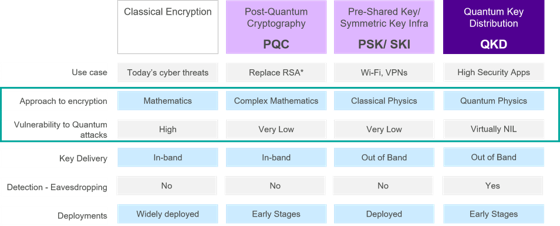
Taken together, the trials give Colt a broader view of the main quantum-safe methods now being evaluated by network operators: post-quantum cryptography, quantum key distribution and pre-shared key or symmetric key infrastructure approaches. Each has a different role. PQC is software- and algorithm-driven, designed to work across existing infrastructure and scale over long distances. QKD is based on quantum physics and key distribution over optical links, but in terrestrial networks it faces distance constraints, with Colt noting the relevance of low Earth orbit satellites as a possible way to extend reach beyond the roughly 100-kilometre terrestrial range limit to transatlantic and subsea distances. PSK and SKI approaches use symmetric quantum-resilient encryption and secure key establishment or key protection mechanisms that can enhance conventional encryption across networks.
The distinctions matter because customers are unlikely to have identical requirements. Colt’s interview responses emphasise that there is no single quantum-safe technology suitable for every use case. The appropriate choice depends on the customer’s security requirements, regulatory obligations, network architecture and long-term risk exposure. PQC and PSK are generally suited to customers seeking scalable quantum-safe protection that can be deployed across existing global networks with minimal infrastructure changes over long distances. QKD may be most relevant for organisations with the highest security requirements, although distance and deployment constraints must be considered. In some cases, hybrid approaches combining PQC, QKD and PSK may offer the best balance of security, operational flexibility, compliance, long-term resilience and cryptographic agility.
Collins and Sundaram characterise Colt’s role as that of an integrator and validator in a live, multi-vendor carrier network environment. Its technology partners contributed specialised quantum-safe technologies, cryptographic expertise and implementation guidance. Colt then used its infrastructure to assess real-world performance, interoperability, operational scalability and readiness for future customer services.
Obstacles to deployment
That real-world emphasis is important because deploying quantum-safe networking over long distances introduces operational challenges beyond the cryptography itself. One central requirement is ensuring that quantum-safe security does not affect network throughput, latency, reliability or operational simplicity. Telecommunications providers must show that PQC and related technologies can operate at the scale and performance levels expected in production networks.

Multi-vendor interoperability remains another significant challenge. End-to-end services often pass through multiple optical transport platforms, encryption systems and management domains, frequently involving different vendors. For large-scale deployment, service providers need consistent security policies, automated orchestration and end-to-end visibility across those environments. PQC also presents technical considerations of its own, because compared with traditional public-key cryptography, many post-quantum algorithms involve larger keys, certificates and cryptographic exchanges. That can increase processing, memory and control-plane overhead, requiring optimisation of both hardware and software for high-speed carrier networks.
Standardisation is another part of the transition. Collins and Sundaram point to the progress made by NIST in selecting and standardising algorithms such as ML-KEM, but note that worldwide harmonisation is still developing. Countries, regions and regulators may adopt different standards, certification requirements, timelines or approved cryptographic suites. For global service providers, those differences may not yet be a major barrier to deployment, but they add complexity when services cross jurisdictions. Colt says this makes cryptographic agility and a vendor-agnostic approach important, allowing networks to support multiple approved algorithms and future standards while maintaining interoperability and complying with regional security requirements.
Where demand is emerging
The demand picture is led by sectors that handle sensitive data with long confidentiality lifecycles. Collins and Sundaram identify financial services, government, defence, healthcare, critical infrastructure and cloud providers as among the industries showing the strongest interest in quantum-safe connectivity. The use cases are centred on protecting high-value information in transit, reducing compliance risk and preparing for future cryptographic threats before quantum capabilities mature.
The company’s list of potential customers reflects the breadth of that demand. Enterprises may look for resilient, secure global connectivity and lower compliance exposure. Global content providers, hyperscalers and neoscalers may explore quantum-safe integration as part of large-scale digital infrastructure. Financial institutions and healthcare providers may require robust protection for sensitive data in transit. Government and defence organisations may prioritise national security and compliance.
The Ciena trial is also positioned against the backdrop of rising AI traffic and increasing demand on global networks. Collins and Sundaram say the demonstration showed outstanding optical performance, stability over subsea infrastructure and readiness to secure AI traffic demands. Buddy Bayer, Colt Technology Services’ Chief Operating Officer, said earlier this year that quantum computing is redefining the security challenge for global connectivity and described the trial as a significant step in protecting data as it moves across continents. He said it shows that quantum-safe protection can be delivered at real-world scale, supported by Colt’s global reach, sustained investment and robust security, and by Ciena’s ability to embed next-generation security into high-speed networks.
Dino DiPerna, Ciena’s Senior Vice President for global research and development, placed the result in the context of rising network demand and the need for operators to raise security standards ahead of quantum-computing risks. He said the Colt-Ciena trial shows how post-quantum cryptography and high-performance optical encryption can help protect high-speed services over real-world long-haul and submarine networks, securing critical in-flight data across any distance.
From trials to mainstream networks
Following this and other optical network trials, Colt says it can offer quantum-safe services based on PQC, QKD, SKI and hybrid models across both terrestrial and subsea networks. The company is looking at a five-year horizon in which quantum-safe networking moves from trial activity into mainstream deployment. Its view is that PQC is likely to become the primary foundation because of its scalability, standardisation and compatibility with existing infrastructure, while QKD and PSK will complement it where customer security or regulatory requirements call for them.
For that shift to happen at scale, Collins and Sundaram identify several conditions: global standards, interoperability across vendors, operators and regions, cryptographic agility, multi-vendor integration, automation, and carrier-grade performance that does not compromise speed, latency, reliability or customer experience. Quantum-safe capabilities, in their view, are expected to become embedded into optical, IP, cloud and encryption platforms rather than remaining niche add-ons.
The latest Colt-Ciena demonstration also follows a longer collaboration between the two companies. In 2025, they announced the rollout of a new terabit network to support two hyperscaler customers or global content providers. In November 2024, Colt and Ciena also announced the completion of what they described as the world’s first 1.2 terabit-per-second wavelength transmission across the Atlantic Ocean. The 800GbE quantum-safe trial now adds a security-focused milestone to that record, showing how high-capacity transatlantic connectivity may be adapted for an era in which data must be protected not only against today’s attacks, but against decryption attempts that may become possible years from now.