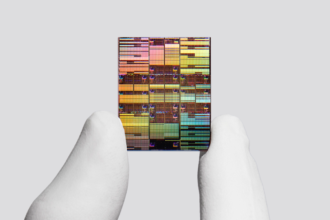





Researchers at the RIKEN Center for Emergent Matter Science and collaborating institutions have demonstrated approximately 99.9% minimum fidelity for five silicon spin qubits operating in parallel, and 99.99% fidelity in individual qubit operations, based on a paper published in Nature Physics.
Using a five-qubit silicon array controlled through a single shared microwave line, researchers identified a key source of errors during the simultaneous operation of qubits and developed a way to mitigate its effects. The results show that a phase-calibration protocol can mitigate errors associated with parallel qubit control, offering a potential route toward scaling up silicon-based quantum processors.

According to Leon Camenzind, a research scientist at RIKEN and co-first author who supervised the experiments, “This shows that high-fidelity control can be maintained even when several qubits are operated at the same time and represents an important step toward scaling up silicon-based quantum processors.”
Silicon spin qubits are a promising platform for building scalable quantum computers as they are compatible with the semiconductor manufacturing technologies used to produce today’s computer chips. However, they have an important weakness: silicon spin qubits typically lose accuracy when several qubits are under parallel control. To be useful, quantum computers will need to operate many qubits simultaneously without compromising the accuracy of their operations.
Unmasking the culprit behind control errors
Quantum computers process information using quantum bits, or qubits, which represent combinations of the conventional binary states 0 and 1. In silicon spin qubits, information is encoded in the spin of an electron trapped in a silicon substrate. Precisely controlling these spins is essential for carrying out quantum operations. However, applying microwave control signals to multiple qubits at once can introduce errors that reduce computational accuracy.

The researchers began their work by finding that the major source of this degradation is a phenomenon known as the AC Stark shift, which is induced by the microwave control signals. This effect changes the effective energy levels of a qubit, shifting the phase of its quantum state and making its operation less precise. When several qubits are driven simultaneously, these shifts can interfere with the intended control of each qubit.
To address this problem, the team developed a scalable mitigation protocol based on phase calibrations. “Rather than requiring an entirely separate calibration procedure for every possible combination of qubits, our method uses calibrations between pairs of qubits to compensate for the unwanted phase shifts,” explains Yi-Hsien Wu, the first author who carried out the experiments as part of his PhD research.
Maintaining accuracy during parallel operation
Using an optimized device design and carefully calibrated microwave control pulses, the team achieved single-qubit gate fidelities well above 99.99% on each of the five qubits when operated individually, with the best approaching 99.999%. Fidelity measures how accurately a quantum operation is performed. Importantly, by using the protocol, they were able to achieve fidelities above 99.99% when up to three qubits were operated simultaneously. During parallel operation of all five qubits, the fidelities remained at approximately 99.9%, a level close to the practical requirements of fault-tolerant quantum computing.
The remaining degradation was attributed to drive-induced decoherence caused by the increased microwave power needed for simultaneous operation. Unlike the phase shifts addressed by the new calibration protocol, this effect involves a loss of quantum coherence. According to Camenzind, “This is a limitation, but further improvements to device design could help mitigate this source of error.”
Toward scalable silicon quantum processors
The results demonstrate that high-fidelity control need not be sacrificed when silicon spin qubits operate in parallel. “By addressing a key source of control errors through pairwise calibration,” says Camenzind, “our study supports the use of shared control lines as a practical approach to scaling up quantum processors. Combined with silicon’s compatibility with established semiconductor manufacturing, we believe that this advance could help pave the way toward larger quantum processors capable of performing increasingly complex computations.”
“Our long-term goal is to build a fault-tolerant quantum computer based on silicon spin qubits, and reliable parallel control is an essential step toward that goal,” adds Seigo Tarucha, project manager of a silicon quantum computing project under JST’s Moonshot Goal 6.
Read the paper here.