


Quantum Security Defence (QSECDEF) is a membership organisation that promotes the safe adoption of quantum technologies, providing its members with access to training, expert networks, and strategic partnerships. Founded in 2024, QSECDEF has grown rapidly and now has over 1200 members from more than 600 organisations.
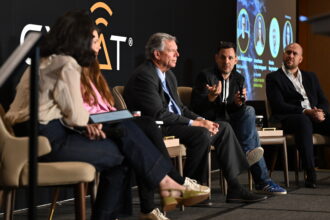
On the sidelines of CYSAT 2026 in Singapore, we spoke with Anna Beata Kalisz Hedegaard, Co-Founder and Chief Executive Officer, about her background and what led her to start QSECDEF. Along the course of the conversation, Hedegaard provided many insights on how to build a successful quantum business, such as the importance of networking, the need to think globally, and how quantum should be seen as part of a larger tech infrastructure.
Drawing from many different industries
Hedegaard said that the quantum industry is inherently interdisciplinary, combining insights from physics, computer science, mathematics, engineering, and even chemistry. Rather than being strictly confined to quantum physics, aspiring entrepreneurs can benefit from exposure to different industries, and help develop broader perspectives that drive innovation.
Her career, for example, has spanned quantum, cosmology, nanomaterials, and electronics. Remarking that her journey may be “seemingly random”, she described her more recent endeavors, “I worked in a European Patent Office, and then I learned about the business behind innovation…I moved to Germany and got into research in the environmental sciences. I did mathematical modeling of air pollution. And it seems like it’s not connected, but I will try to join all the dots. The thing is that if you’re studying environmental sciences, first of all, you learn about simulation. You get a lot of data, and that’s how I got, for example, into AI and machine learning. But you also learn how to visualize something very complex on maps, and how things are interconnected. That’s a big part of geosciences. And then I got headhunted as a patent engineer. The team that I belonged to was working on AI, blockchain and quantum computing. And I was observing innovation, as a lawyer in training. it opened up another aspect of the business of innovation.”
The importance of networking in entrepreneurship
A key priority for aspiring entrepreneurs, highlighted Hedegaard, is to network and communicate with as many people as possible – even before having a clear business plan in mind. Engaging with a wide range of people, she explained, provides valuable insights and helps anchor ideas in real-world perspectives. It can also help identify gaps in the market.
She said, “For around a year, I was mostly pitching my ideas, refining my ideas and trying to find a way to do it. But while doing that, I met people in quantum defence. We identified that there is an issue in communicating technology. So there is this gap between scientific fascination and communicating business value, and with having real applicability and matching it with engineering feasibility. We registered Quantum Security Defence in the UK, and we started to talk to people. We try to see what their pain points were, and then actually, the business model emerged from their responses.”
Why it’s necessary for quantum businesses to have a global mindset
Hedegaard encourages quantum companies to think globally, not only because quantum is a niche sector, but also because the international market offers greater learning opportunities. Quantum Security Defence, for example, is registered in the UK, and the team comprises people based in Germany, France, Czechia, Poland, the Philippines and Canada.
She explained, “Since it is an emerging field, locking it into a national [market] is too constraining. So we are inherently global. There’s a lot to learn from each other, so even if your target is the national market, at this very early stage, you can really learn by interacting with global players. And I would also suggest maybe trying to do business abroad, because with all that knowledge, you’re going to be a leader in the national market. Because you’re going to bring experience and know-how from around the world, back to your country, where the value of that is going to be so much higher. The complexity of your understanding of the problem is going to be so much better.”
Validating a technology through the lens of the defence sector
For businesses trying to evaluate the practical or commercial viability of their technology, Hedegaard recommends engaging with the defence sector. This, she said, helps to clearly assess product quality without being distracted by cost considerations.
“The defence sector is a very nice lens, because they are, on the one hand, very progressive – lots of modern technology actually comes from defence, They are the pushers of a lot of innovation. But on the other hand, the technology is supposed to be operational, so it really has to work. It has to really deliver on the promise. And interestingly, money is not their showstopper. If they see value, and it really delivers what they need, they’re ready to put money into it. So that is a very interesting lens to put on an emerging technology.”
With this perspective in mind, businesses can then run their technology through a checklist.
“You can say, ‘First, does that technology make sense? Does it deliver value? Is it ready to deliver value on an engineering or practical level? And you can start to implement it, even if it’s expensive to produce. And if you check all the boxes, then that’s the moment you should also think of how to make it commercial and scalable. And then roll it out into society, because that’s where even bigger money will be. It was like that with the semiconductor,” she continued.
Understanding client needs by viewing quantum within its broader context
Most organisations, Hedegaard said, do not adopt quantum in isolation but are instead integrating it into complex, interconnected systems that include AI, cybersecurity, and digital infrastructure.
She explained, “People look at quantum computing and what it would bring to their company, especially in bigger organisations. It’s interconnected. It’s so interdisciplinary. A good example is, we are rolling out AI agents all over the place. From a cybersecurity angle, AI agents are a real thing. How would you secure it? In doing so, you would probably find out about post-quantum cryptography (PQC). Everything is connected.”
For this reason, she argued, quantum companies must understand how their technology fits into a larger whole and be able to communicate their value in a specific manner.
“If you’re only a provider of a product, you might only focus on something small, but you always have to have at least an understanding of the bigger picture, of the real need. So if I am producing a PQC protocol, but I have no idea what a giant organization is actually struggling with and what their reality is, I have no way to communicate my value. I just tell them, ‘buy it, it’s great.’ They have a phone call every minute with someone trying to sell them something. But for example, if you say, ‘Well, I know that you have the workflows from your agents that are going havoc, that opens vulnerabilities here and here and here, and our protocol would be able to take care of that,’ then you start to speak about something that they actually live in. So understanding where you’re pitching your solution, so that it actually solves the problem is everything,” she concluded.