


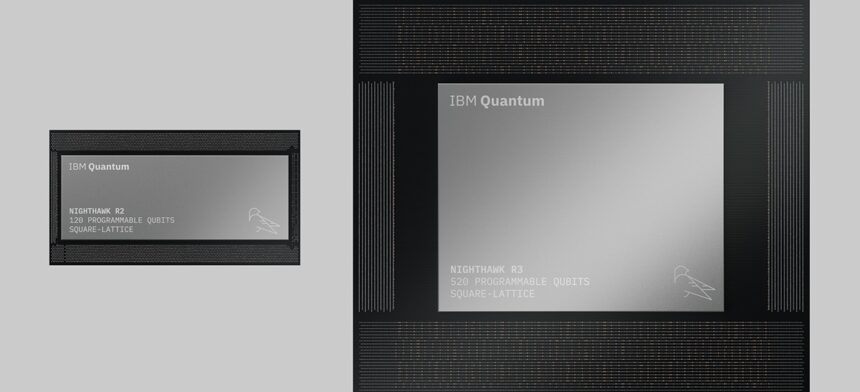
IBM announced IBM Quantum Nighthawk r3, its next-generation processor, will be built to accurately execute 10,000 quantum operations across 520 qubits to tackle larger, more complex problems than the current generation Nighthawk available today. In 2027, IBM plans to link two Nighthawk r3 processors into a single system with more than 1,000 qubits.
To be at the frontier of quantum computing, industry-relevant applications demand both computational quality and speed. Speed matters because a quantum computer delivers its answer in samples: each run of a quantum circuit returns one result. Applications increasingly require circuits executing thousands of quantum operations on approximately 100 qubits or more, generating millions to billions of samples. Scale and quality enable increasingly complex computations, but speed determines whether these demanding workloads can be completed in practical timeframes and at a reasonable cost.

“Useful quantum computing hinges on whether results can be delivered with accuracy and speed, both are fundamental,” said Jay Gambetta, Director of IBM Research and IBM Fellow. “Nighthawk is already showing us what that looks like today. As we scale this architecture to larger and more powerful quantum computers, the capabilities of quantum computation will reach new levels as we integrate more closely with classical resources and march ahead to fault tolerance.”
Nighthawk r2
Introduced in September, IBM Quantum Nighthawk r2 reportedly delivers up to 100,000 samples per second while supporting more than 7,500 quantum operations on 120 qubits. According to IBM, clients and partners including E.ON, Algorithmiq, and Q-CTRL have executed 34 billion circuits on Nighthawk r2 to date, reporting performance improvements of up to 19x.

Case studies highlighted by IBM include the following:
- E.ON reported a 15x speedup on Nighthawk r2 in quantum machine learning for energy grid optimization.
- IBM reported a 12x speedup of an experiment ran earlier this year with Oak Ridge National Laboratory, which simulated real magnetic materials and produced results consistent with neutron scattering experiments.
- Quantum Elements and ParityQC have also reported significant performance improvements on their own workloads.
Nighthawk r3: Scaling to More Than 1,000 Qubits
Building on the performance demonstrated by Nighthawk r2, Nighthawk r3 is designed to support 10,000 quantum operations on 520 programmable qubits, with 2,034 total physical qubits. It retains r2’s square-lattice connectivity while introducing 10 chip-to-chip interconnects, called l-couplers, designed to connect processors into larger systems.
IBM said it has already demonstrated two critical technologies that enable this modular approach. This year, IBM connected Nighthawk r1 processors using four l-couplers, achieving 99.3 percent quantum state transfer fidelity and progressing toward its 99.9 percent target. IBM also connected two cryogenic modules into a single system for the first time, reaching operating temperature in under five days and cooling below 15 millikelvin. In 2027, IBM plans to connect two Nighthawk r3 processors into a single 1,040-qubit system, extending its high-performance architecture to larger and more complex computations.