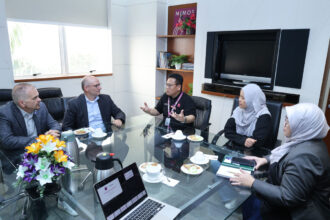





Japan’s quantum industry is working to strengthen the links between research, industrial applications and international collaboration. For Hiro Nakata, Board Member of Japan’s Quantum Strategic Industry Alliance for Revolution (Q-STAR), the priority is to build an ecosystem that can translate quantum technologies into practical industrial applications while developing the skills, standards and partnerships needed to support their adoption.
Also the Chief Operating Officer of JIJ and CEO of JIJ Europe, Nakata sees Japan’s industrial base and participation by end-user companies as important advantages, and believes the country can strengthen its position in the global quantum industry by developing applications that address real industrial problems.

In Part 1 of an interview conducted on the sidelines of LEAP East in Hong Kong earlier this year, Nakata discussed JIJ’s work and the future of quantum optimization. This second part focuses on how Japan’s quantum ecosystem is evolving, Q-STAR’s partnerships in Europe, and Japan’s government initiatives and investments.
Building a use-case-driven quantum ecosystem
Q-STAR was established in 2021 with 24 companies and has since grown to more than 150 member companies and institutions, including large corporations, small and medium-sized enterprises, startups and academic institutions.
For Nakata, the organisation’s development reflects an opportunity to connect quantum research more directly with industrial implementation.

What I am most excited about is Japan’s ability to show the world an ecosystem that is not only research-driven, but genuinely use-case-driven—connecting quantum technologies to industrial implementation.
He listed three priorities for the next stage of development: (a) identifying the problems industries need to solve, such as optimisation problems, and translating them into forms suitable for quantum workloads, (b) establishing repeatable implementation processes that go beyond Proofs of Concept (POCs), and (c) strengthening role-sharing and bridges across industry, academia, government, and startups so that research outputs can become usable deployments.
According to Nakata, Japan already has several advantages on which to build. He pointed to its strong base of end-user participation, the availability of real-world industrial problems, and the country’s strengths in components and supply chains.
“Japan has a strong base of end-user participation and rich real-world problems, as well as strengths in components and supply chains,” he said, describing how he believes that Japan’s competitiveness can be strengthened by continuously developing and addressing new use cases, and then adapting these applications for the global market.
Developing quantum literacy and supporting startups
Recent Q-STAR initiatives address the development of skills and the startup ecosystem alongside industrial implementation.
In February 2026, Q-STAR published version 1.0 of its Quantum Literacy Standard (QSS-L). The publicly available guideline is intended to help people acquire the basic knowledge needed to understand quantum technologies and their potential applications in society.
The initiative addresses the need to broaden understanding beyond a relatively narrow group of specialists. As organisations explore potential applications, a wider base of people who understand quantum technologies, said Nakata, could help support their adoption.
Q-STAR also held Quantum Startup Day 2026 on 27 February at Tokyo Innovation Base, an innovation hub and startup-friendly center launched by the Tokyo Metropolitan Government. The event, said Nakata, featured “keynote updates and pitches from 12 quantum startups, creating opportunities for collaboration and investment between corporates and startups.”
These initiatives target the different needs of the ecosystem: developing foundational knowledge, creating opportunities for emerging companies, and strengthening connections between technology developers and potential industrial partners.
For Nakata, the broader objective remains practical implementation. He observed that Japan’s competitiveness will depend not only on developing quantum technologies, but also on identifying suitable problems, building the necessary expertise and establishing processes that allow solutions to be evaluated and deployed.
Collaboration across Japan and Europe
Nakata is also active in UKQuantum and the European Quantum Industry Consortium (QuIC) and views international collaboration as supporting Japan’s quantum policy.
“Based in London, and with JIJ operating across Japan, the UK, Europe, and the US, I see Japan’s national strategy and international collaboration as complementary rather than competing,” he said.
Nakata argues that the industry needs to develop common approaches to benchmarking and validation so that results can be reproduced rather than remaining isolated demonstrations. This requires progress in standardisation, data and evaluation frameworks, talent mobility and access to testbeds.
The greatest value of international collaboration is building an environment where we can evaluate and implement solutions with shared benchmarks, shared validation processes, and shared operational learnings across borders.
He cited the example of Q-Neko (EU–Japan Quantum HPC Consortium), which brings together European high-performance computing (HPC) and quantum stakeholders with Japanese partners. Together, they seek to advance practical benchmarking and use-case validation on hybrid computing foundations that combine HPC and quantum computing.
The collaboration, said Nakata, creates opportunities to connect Japanese industrial use cases with European testbeds and evaluation environments. It also supports the development of benchmarking frameworks that consider not only computing performance, but also operational requirements.
He said, “In such a framework, I see major synergies in: connecting Japan’s strong industrial use cases to European testbeds and evaluation environments; building benchmarking frameworks that include not only compute performance, but also operational requirements (reproducibility, auditability, integration) and accelerating implementation through talent mobility and knowledge transfer.”
Japan’s expanding investment commitments
On 24 June 2026, the Government of Japan published a Public–Private Investment Roadmap setting out investment expectations exceeding JPY 370 trillion (app USD 2.34 trillion) across 17 strategic areas through fiscal year 2040. The total includes public and private investment and covers areas including artificial intelligence, semiconductors and quantum technologies.
Within the quantum sector, the roadmap specifies investment expectations of JPY 10.3 trillion (app USD 65.22 billion for quantum computing), JPY 1.5 trillion (app USD 9.5 billion) for quantum communication and networks, and JPY 1.4 trillion (app USD 8.86) for quantum sensing. Together, these three areas account for approximately JPY 13.2 trillion (app USD 83.57 billion) in expected investment through fiscal year 2040. Overall, the figures represent investment expectations rather than funding already allocated or investment already realised.
Nakata welcomed the government’s increased commitment to the sector, remarking, “Japan’s expanding commitment to quantum is a very encouraging tailwind.”
For companies operating in the industry, however, the challenge is to translate national investment ambitions into technical capabilities, industrial partnerships and practical applications.
His emphasis on implementation provides a useful perspective on the relationship between public investment and commercial progress. Funding can support research, infrastructure and company development, but adoption also requires suitable use cases, skilled teams, shared evaluation methods and effective collaboration.
These requirements connect the government’s investment ambitions with initiatives such as Q-STAR and Q-NEKO, which bring together organisations and provide frameworks for developing and evaluating applications.
Turning industrial strengths into global opportunities
For Nakata, the next stage is to make these connections more effective in moving from research to implementation. This involves identifying industrial problems suitable for investigation, creating repeatable processes for evaluating solutions, and strengthening cooperation among companies, researchers, government organisations and startups.
Japan’s investment roadmap provides a long-term framework for the sector, while initiatives focused on implementation, skills and international partnerships address the practical work required to develop an industrial ecosystem.
Concluding, he said, “I believe the next critical step is strengthening commercialisation support in addition to research funding—for example, procurement and demonstration pathways that help move from PoC to production, standardisation, support for global expansion of startups, increased talent mobility, and mechanisms to accelerate collaboration between large enterprises and startups. Strengthening this “bridge between research and market adoption” will further speed up industrialisation.”