



NVision, which is developing quantum technologies for healthcare, has announced a $55 million Series B financing round anchored by Abbott. The company also announced a major expansion from quantum sensing into quantum computing, and will use what it calls Photonic Integrated Quantum Circuits (PIQC), a new quantum computing platform built on its molecular quantum technology using single photon-emitting organic molecules.
The Series B includes a $17 million venture loan from the European Investment Bank (EIB). The round is anchored by Abbott, with participation from Playground Global, Matterwave/b2ventures, Entrée Capital, and others. The new funding brings NVision’s total capital raised to $120 million.

Abbott joins as the sole strategic investor in diagnostics, reflecting its interest in exploring how NVision’s quantum technologies can be applied across the diagnostic field. The investment provides Abbott with early access to emerging capabilities in quantum sensing and computing, supporting the evaluation of future applications in disease detection, monitoring, and clinical decision-making.
Quantum sensing, and the discovery of a new class of molecule-based qubits
The company’s quantum-enhanced sensing platform, POLARIS, already uses quantum technology to boost the MRI signal of sugar-based imaging agents, enabling real-time measurement of metabolism on standard MRI systems. This allows researchers to assess treatment response within hours to days based on disease biology, rather than relying on traditional imaging that can take up to months to show changes in morphology.
Building on the quantum molecular approach behind POLARIS, NVision is now extending its platform into quantum computation. While developing its MRI signal enhancement technology, NVision discovered a new class of organic molecule-based qubits. With this expansion, NVision believes it can lay the foundation for a new quantum-driven approach to drug development. According to the company, quantum computing will enable the design of more effective drug candidates, including for previously inaccessible targets, while quantum-enhanced MRI with POLARIS will rapidly validate them in the real biological environment. Together, this will establish a unified “compute and validate” approach, combining quantum computing for design with quantum sensing for real-world validation.

POLARIS systems are already being installed at leading cancer centers worldwide and are expected to be deployed in approximately 20 centers across the U.S., Europe, and Asia by the end of the year. Sites include Memorial Sloan Kettering Cancer Center, the University of Cambridge, and the Technical University of Munich.
PIQC and Organic Qubits
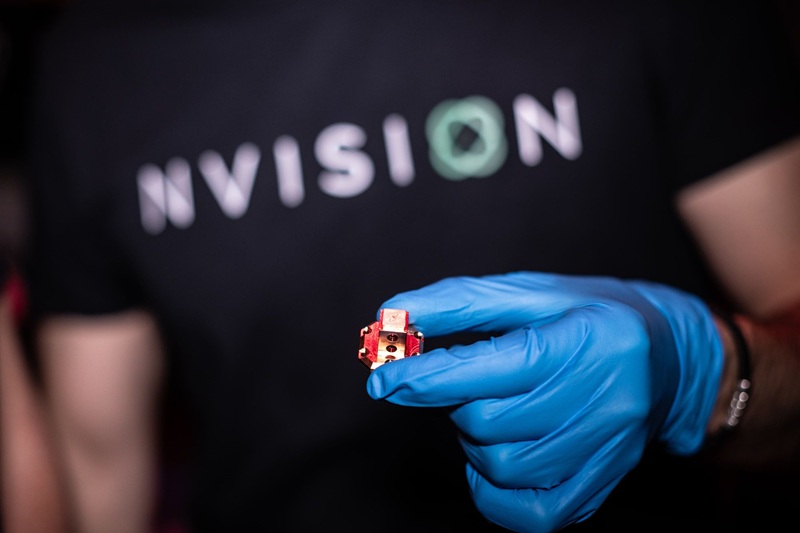
Drawing on the experience with POLARIS, NVision is extending the same molecular approach into quantum computing. The architecture is designed from first principles with scalability as a requirement. At its core are single photon emitting organic molecules forming an entirely new class of qubits, fundamentally different from legacy approaches.
The new qubits are now being integrated as a thin organic layer directly onto photonic chips, forming the basis of NVision’s quantum computing platform: Photonic Integrated Quantum Circuits (PIQC, pronounced “Pixie”). By combining this molecular layer with established photonic hardware, the approach enables a scalable path to building quantum computers using standard semiconductor manufacturing technologies.
“I see a future where quantum computers generate an explosion of drug hypotheses for diseases that are exceptionally difficult to treat today,” said Sella Brosh, CEO and Co-Founder of NVision. “As we expand our ambition into quantum computing, building on our remarkable new class of organic molecule-based qubits, that future comes closer. But without translational speed, we won’t fully realize those gains. POLARIS is built exactly to address this, enabling rapid in-vivo validation and closing the loop between design and reality.”
“NVision is fundamentally changing how we find, diagnose, and treat cancer by making the biology of disease visible in ways that weren’t possible before,” said Peter Barrett, General Partner, Playground Global. “That same molecular quantum capability now enables both the design and testing of new therapies – defining a new category in quantum health.”