


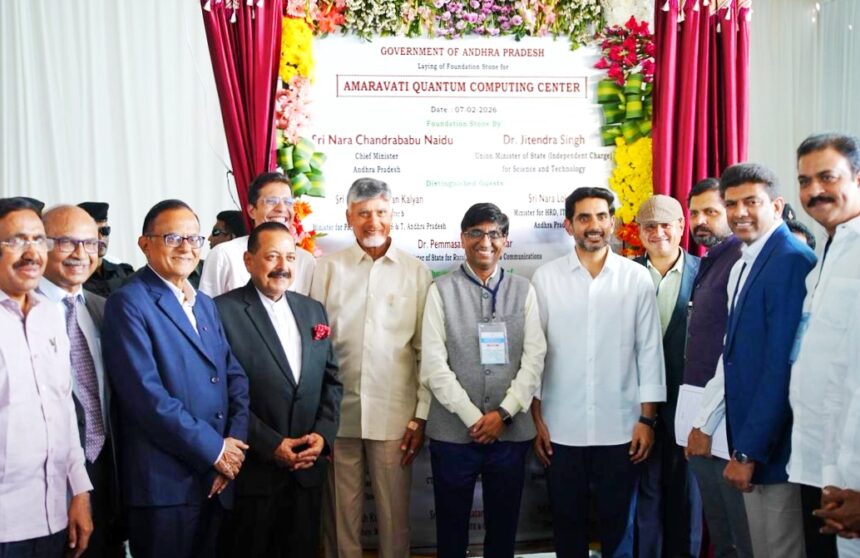
On 7 February 2026, construction officially began on India’s Amaravati Quantum Valley, the nation’s first quantum tech park, located in the southern state of Andhra Pradesh. The occasion was marked by the laying of the foundation stone by Andhra Pradesh’s Chief Minister Nara Chandrababu Naidu.
The project was first announced in March 2025, and will be a 50-acre campus hosting research organisations, industry players, and startups. Aside from laboratories and other such facilities, the Quantum Valley will be equipped with IBM’s Quantum System Two, comprising a 156-qubit Heron quantum processor, which will be the largest quantum computer hosted in India. The installation of IBM’s system was announced in May last year, as part of an agreement between the Government of Andhra Pradesh, IBM, and Tata Consultancy Services (TCS).

Besides the laying of the foundation plaque, the event on 7 February also featured the launch of IBM and TCS Cloud Services, the establishment of the IBM-TCS Quantum Innovation Centre, and the announcement of the following new initiatives: a Quantum Talent Hub, a Quantum Reference Facility by SRM University, a Quantum-Safe Applications initiative. Multiple Memoranda of Understanding (MOUs) were also signed between nine industry partners, the government, and academic institutions.
Attending the event was Dr Jitendra Singh, Union Minister of State (Independent Charge) for Science & Technology, Earth Sciences, and MoS PMO, Personnel, Public Grievances, Pensions, Atomic Energy and Space.
In a public address, Dr Singh revealed that he has had discussions with Chief Minister Naidu on the possibility of launching structured quantum academic programmes in Andhra Pradesh, supported by trained faculty and institutional collaboration. He added that advanced fabrication facilities and central research infrastructure are being established and will be accessible to startups, researchers, and academic institutions.

During his address, he also described quantum technology as a strategic necessity rather than an option, if India seeks to secure its communication systems, defence architecture, healthcare innovation, and global technological standing in the coming decades. He also remarked that India is one of the few nations with a dedicated national quantum programme, referring to the ₹6,000 crore(US$720 million) National Quantum Mission, which aims to: (1) develop quantum computers with up to 1,000 physical qubits within eight years, (2) establish secure ground-to-ground quantum communication networks, enabling long-distance quantum communication, and (3) achieve inter-city Quantum Key Distribution across 2,000 kilometres.
He also spoke about transformative healthcare applications, including precision radiation therapies capable of targeting tumours without collateral damage, adapting dynamically to organ movement and enabling faster patient recovery. Quantum technology, he said, will similarly redefine satellite communication, secure communications infrastructure, and advanced sensing capabilities.