



India’s Manipal Academy of Higher Education (MAHE) is establishing a new quantum technology centre in Bengaluru aimed at strengthening India’s domestic quantum hardware ecosystem, with a targeted opening date of September 2026. The initiative, called Quantum-Hub@MAHE (Q-HUB@MAHE), will be located at the Manipal Institute of Technology, Bengaluru (MIT-BLR) campus and is intended to support research, workforce development and industry collaboration in quantum hardware.
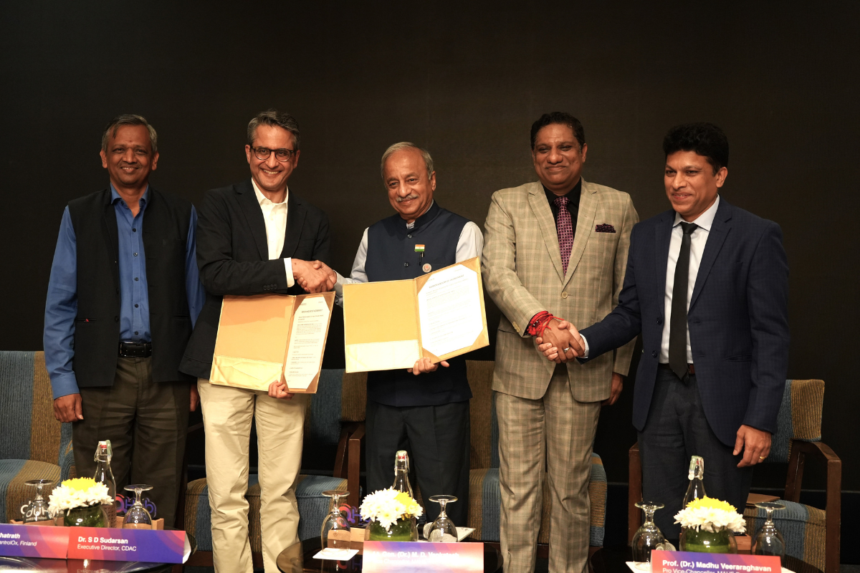
During the launch, MAHE signed Memorandums of Agreement (MoA) with QuantrolOx (Finland) in association with Bluefors (Finland), QBLOX (Netherlands), ConScience (Sweden), and the Centre for Development of Advanced Computing (C-DAC), under the Ministry of Electronics & Information Technology.

Conceived as an integrated design-to-deployment platform, Q-HUB@MAHE brings together quantum hardware experimentation, deep-tech startup incubation, component innovation, workforce development, testing infrastructure, and translational research within a unified academic framework. The initiative is structured to strengthen India’s sovereign capability across the quantum value chain.
As part of this multi-campus deep-tech strategy, Manipal Institute of Technology, Bengaluru (MIT-BLR) will serve as the operational anchor for advanced hardware experimentation, cryogenic and RF infrastructure, and structured quantum engineering education and training.
The facility will commence operations with a 25-qubit dilution refrigeration (DR) open-architecture system designed for advanced training and experimentation. This marks the first phase of a structured roadmap progressing from sub-50 qubit training systems to 50–150 qubit proof-of-concept platforms and ultimately toward 150–1,000+ qubit industrial-grade quantum product systems.

Unlike access-based or vendor-locked deployments, Q-HUB@MAHE has been designed as an open-architecture ecosystem supporting indigenous component development, calibration systems, hardware integration, and scalable manufacturing pathways. The long-term vision includes indigenous Quantum Processing Unit (QPU) development, system miniaturisation, and industry-ready quantum hardware platforms.
The initiative was formalised through Memorandums of Agreement (MoA) with QuantrolOx (Finland) in association with Bluefors (Finland), QBLOX (Netherlands), ConScience (Sweden), Centre for Development of Advanced Computing (C-DAC), under the Ministry of Electronics & Information Technology.
These collaborations establish a structured Year-1 roadmap focused on workforce development, hardware experimentation, IP co-development, and national testing infrastructure aligned with the strategic pillars of the National Quantum Mission.
Q-HUB@MAHE has set a target of training 100 quantum engineers by December 2026 through a structured certification programme combining online modules, assessments, and hands-on laboratory immersion. The centre will also function as a national testing and measurement gateway, enabling researchers, startups, and industry partners to access advanced infrastructure.
Lt. Gen. (Dr.) M. D. Venkatesh, Vice Chancellor, MAHE, said: “Q-Hub@MAHE reflects our commitment to building sovereign scientific capability aligned with the vision of the National Quantum Mission. By integrating research, hardware development, and workforce training within one ecosystem, we aim to contribute meaningfully to India’s leadership in advanced quantum technologies.”