


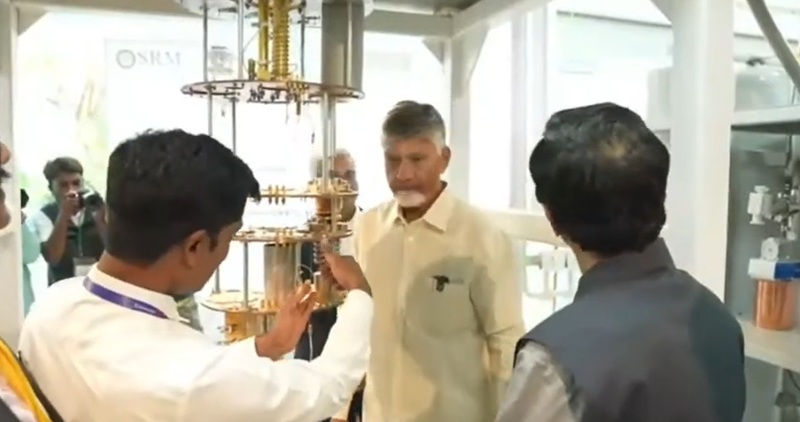
On 14 April, India launched its first open-access Quantum Reference Facilities, consisting of two superconducting quantum computers purpose-built by local startup Qbit Force to serve as hardware testbeds. The commissioning took place at the new Amaravati Quantum Valley (AQV) in the state of Andhra Pradesh, in a ceremony inaugurated by Andhra Pradesh Chief Minister N. Chandrababu Naidu.
The testbeds were built using predominantly indigenously-developed components from various institutes in India. Known as Amaravati 1S and Amaravati 1Q, they are hosted at SRM University and Maida Towers respectively, and will serve as the foundational infrastructure for AQV. Amaravati 1S will be primarily dedicated to academic research, benchmarking, and workforce development, while Amaravati 1Q will function as a commercial-grade hub intended for industrial testing, startup incubation, and the deployment of quantum-ready applications. Students from SRM University, where one of the testbeds is hosted, were part of the development and assembly team.

During a technical tour of the facility, Dr. L. Venkat Subramaniam, founder of Qubit Force, explained the unique “open-access” nature of these laboratories. “Usually, quantum computers are hidden behind clouds or kept in restricted corporate labs,” Dr. Subramaniam noted. “These facilities are different. They are reference facilities where any researcher, startup, or student can bring their own components—be it a new type of wiring, a sensor, or a processor—and test them in a high-fidelity quantum environment”. He added that the systems allow researchers to validate individual quantum components, where they can swap hardware in and out under real-world operating conditions.
The quantum computers were developed through a collaboration between various institutions and industry partners, including:
Processors made in Tata Institute of Fundamental Research (TIFR) and Indian Institute of Science, Bangalore

Dilution refrigerator by Sidwal
Flexible wires by Indian Institute of Technology Bombay (IIT Bombay)
Precision power supplies by Inter-University Accelerator Centre, Delhi (IUAC-Delhi)
Control systems by Defence Research and Development Organisation