



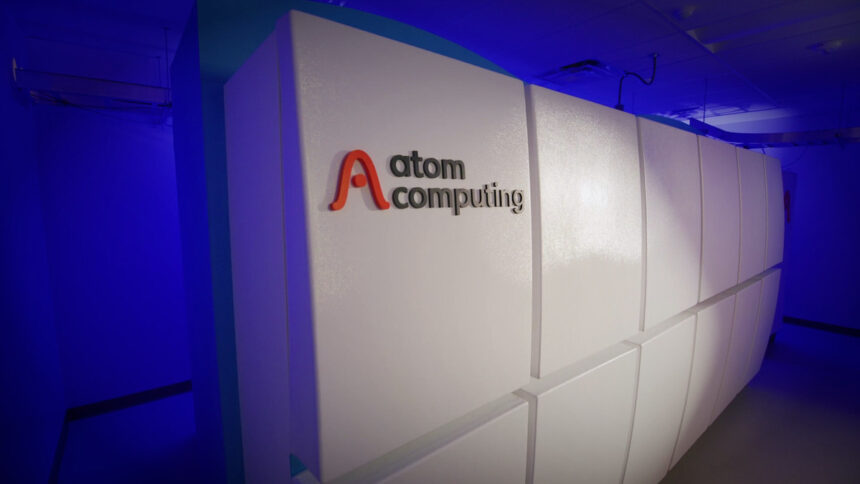
Atom Computing has announced the industry’s first full demonstration of quantum error correction using a toric code.
The results show that the company’s neutral-atom system reduces errors as larger numbers of qubits are used in computations, placing Atom Computing among only two companies that have demonstrated many rounds of sustained quantum error correction and marking the first time this has been achieved using neutral atoms.

Ben Bloom, CEO and founder of Atom Computing, said they have shown that practical quantum error correction can be achieved with the company’s neutral-atom technology.
“This is the clearest demonstration yet that neutral atoms are highly competitive with superconducting systems and other approaches for building scalable logical qubits,” he said.
“We’ve reached this milestone faster and with greater capital efficiency than larger players in the industry, and we’re excited to build on this progress and share more results later this year,” added Bloom.
Quantum error correction is essential to unlocking the full potential of quantum computing. Quantum systems are sensitive to noise and errors, which must be detected and corrected repeatedly across many rounds of operations to ensure reliable results.
A key requirement for effective error correction is that the error rates of logical qubits decrease as the system scales up. Atom Computing said the results demonstrate that its neutral-atom systems meet this requirement, accelerating the path to utility-scale quantum computing.
Atom Computing said its architecture and proprietary technologies were critical to achieving these results. For example, its ability to dynamically rearrange qubits enables all-to-all connectivity, removing the constraints of fixed hardware layouts found in other modalities.
The system’s zoned architecture supports highly parallelized operations enabling faster overall computation, and Atom’s nuclear-spin qubits exhibit record-breaking coherence times, which are essential for running deep, complex algorithms.
Together, these features enable fast algorithm execution and greater flexibility in algorithm design, crucial to achieving this milestone in neutral atom computing.
“This looks like exciting progress toward fault-tolerance for neutral-atom quantum computers — specifically, in repeatedly refreshing the atoms in a way that preserves the logical information. Congratulations to Atom Computing on its accomplishment,” said Scott Aaronson, professor of Computer Science at the University of Texas at Austin and director of its Quantum Information Center.
The technical achievement directly supports Atom Computing’s expanding commercial footprint. Last year, the company sold the world’s first commercial quantum computer with logical qubits to QuNorth, a Nordic quantum initiative funded by EIFO and the Novo Nordisk Foundation.
Currently being installed in partnership with Microsoft, the on-premises quantum system, Magne, is paving the way for advanced regional collaborations.
“Demonstrations like this of increased fidelities through quantum error correction are important proof points that we’re on the right trajectory toward utility‑scale quantum systems,” said Matthias Troyer, technical fellow and corporate VP at Microsoft Quantum.
With this milestone, the company’s participation in stage B of the DARPA Quantum Benchmarking Initiative and having recently signed a Letter of Intent with the United States Department of Commerce for $100 million of funding, Atom Computing continues to push the boundaries of quantum technology, bringing reliable, utility-scale quantum computing closer to reality.