



Qunnect and Cisco have announced the first entanglement swapping demonstration of its kind over deployed metro-scale fiber using a commercial quantum networking system. The demonstration combined Qunnect’s quantum hardware with Cisco’s quantum networking software stack to validate a new spoke-and-hub model for scaling quantum networks through commercial data centers.
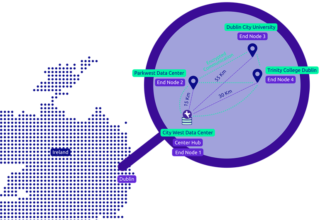
To validate this model, the companies conducted a demonstration on Qunnect’s GothamQ testbed, which runs throughout New York City. The network spanned 17.6 kilometers of deployed telecom fiber connecting Brooklyn and Manhattan through QTD Systems’ data center at 60 Hudson Street.

The collaboration achieved swapping rates of 1.7M+ pairs/hour locally and 5,400 pairs/hour over deployed fiber, which Qunnect says is nearly 10,000 times better than previous benchmarks using similar platforms. As the first demonstration of polarization entanglement swapping over deployed fiber, the system maintained >99% polarization fidelity. These results demonstrate the integrated system can operate reliably in one of the world’s most demanding urban environments, providing a deployable blueprint for distributed quantum computing and secure metro-scale quantum networks.
“Entanglement swapping is a fundamental operation in the quantum internet. Today, we not only broke the record for rate and scalability, we did so in New York City using some of the noisiest, most chaotic fiber on Earth,” said Mehdi Namazi, Co-Founder and Chief Science Officer for Qunnect. “This is a milestone the field has been waiting for, and it was proven possible by Cisco and Qunnect.”
According to Qunnect, the demonstration achieved the following key milestones:

High Throughput: Record swapping rates of 1.7M+ pairs/hour (local) and 5,400 pairs/hour (deployed).
Signal Stability: Maintaining ultra-high quality entanglement across all nodes using a fully automated, 24/7 operational system.
Cost-Effective Architecture: End nodes utilized room-temperature detectors, concentrating cryogenic equipment solely at the central hub to significantly reduce the cost of network scaling.
Untethered Scalability: Independent entanglement sources require no shared lasers, allowing for modular network expansion.
These were achieved using Qunnect’s Carina system to generate entangled photon pairs, as well as the company’s s Automatic Polarization Controllers (APCs) [LINK] to compensate for polarization drift. These technologies were integrated with Cisco’s unified quantum networking software stack.
“This milestone accelerates our quantum networking vision. Our orchestration software enabled field-ready entanglement distribution and swapping—foundational capabilities for distributed quantum computing and the global quantum grid,” said Reza Nejabati, Head of Quantum Research at Cisco.
Quantum networks today are often constrained by a complex physical “tether,” relying on a shared master laser to connect all nodes. The experiment removed the need for nodes to be physically “tethered” by shared lasers, achieving a decoupling of nodes that allows for a scalable hub-and-spoke architecture for quantum networking, enabling new endpoint nodes to be added without dedicated synchronization links to all other nodes.
The scientific paper is available on ArXiv.