


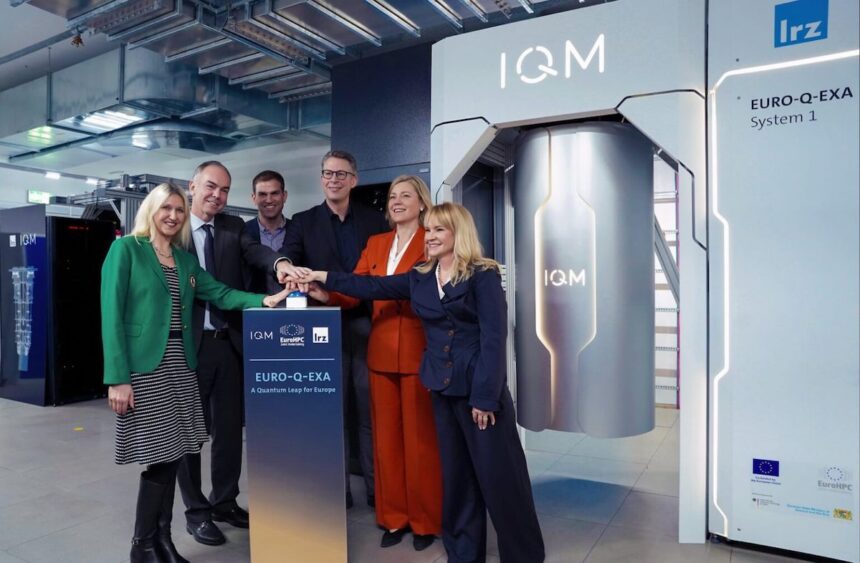
Euro-Q-Exa, the first EuroHPC Joint Undertaking quantum computer deployed in Germany, was unveiled at the Leibniz Supercomputing Centre (LRZ) in Garching, Munich.
The deployment marks a significant step in Europe’s effort to build long-term quantum capability as part of its sovereign digital infrastructure, alongside world-leading high-performance computing (HPC).
Installed, hosted, and operated at LRZ, Euro-Q-Exa is designed not merely to provide access to quantum computing, but to enable European researchers to build, operate, and scale quantum capabilities locally.

By embedding the system within an established HPC environment, the system supports the development of hands-on expertise, operational know-how, and sustainable research capacity within Europe.
Euro-Q-Exa strengthens Europe’s quantum ecosystem by enabling local capability building; European IP creation and retention; deep HPC–quantum integration and; ecosystem collaboration.
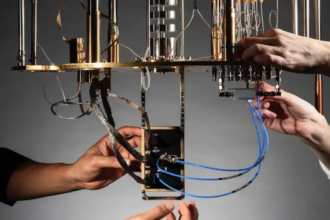
The system is based on the Radiance platform of IQM and features 54 superconducting qubits. Euro-Q-Exa will be complemented by a second, more powerful system of 150 qubits by the end of 2026, further expanding Europe’s operational quantum capacity.
By integrating Euro-Q-Exa directly into LRZ’s supercomputing environment, European researchers can develop, test, and scale hybrid quantum–HPC applications in areas such as neurodegenerative disease research, computational pharmacology, and climate modelling.
This approach allows quantum technologies to mature within operational research environments and supports their transition toward sustained scientific and industrial use.
Euro-Q-Exa is one of six quantum computers being integrated into Europe’s most advanced supercomputing centres, alongside installations in Czechia, France, Italy, Poland, and Spain, reinforcing Europe’s coordinated approach to sovereign digital infrastructure.
Henna Virkkunen, European Commission’s EVP for technological sovereignty, security and democracy, said that as the quantum market is still nascent, the European Commission is actively shaping it.
“Through EuroHPC, and together with Member States, we have already procured and co-funded the first six European quantum systems,” said Virkkunen. “Four are operational, and two more are under procurement. This is a clear demonstration of Europe’s commitment to building sovereign quantum capacity on our own continent.
She said the Leibniz Supercomputing Centre stands as a concrete example of this ambition in action.
“It shows how we can successfully support and scale up leading European providers such as IQM, who are at the forefront of quantum innovation,” said Virkkunen.
“By anchoring these systems in Europe, we are strengthening our industrial base and ensuring that strategic technologies are developed and deployed in Europe, for Europe,” she added. “With the new system — and its substantial upgrade planned for early 2027 — we are already enabling complex quantum computations today. This is not a distant promise; it is operational reality.”
Markus Blume, Bavarian Minister of State of Science and the Arts, said that Germany’s first European quantum computer is being installed at the Leibniz Supercomputing Centre in Bavaria as a result of the state’s strong high-tech ecosystem.
Blume said Euro-Q-Exa represents technological sovereignty and Bavaria’s ambition to develop our own digital infrastructure.
“At Germany’s largest research campus in Garching, a vibrant hub for European ideas, we are combining quantum computing, supercomputing and artificial intelligence to create new dimensions in computing,” he said. “This is precisely why we are also applying to host an AI gigafactory. Projects like this demonstrate Bavaria’s readiness to take responsibility for Europe’s digital future.”
Anders Dam Jansen, executive director of EuroHPC Joint Undertaking, said the new EuroHPC quantum system reinforces their commitment to providing researchers, industry, and the public sector with cutting-edge computational resources, fostering innovation and technological sovereignty across Europe.
Dieter Kranzlmüller, chairman of the board of directors, LRZ: “With Euro-Q-Exa, we are combining the strengths of quantum and supercomputing. This gives researchers the opportunity to test new approaches and implement groundbreaking calculations, opening up new scientific dimensions using European technology. Here at LRZ, we are looking forward to embarking on some exciting research projects and gaining new insights.”
Jan Goetz, CEO of IQM Quantum Computers: “The countries that own their open quantum infrastructure, not just access to the cloud will lead. Europe is building toward that: locally operated systems, education of the new generation, hybrid HPC integration, and the institutional expertise that only comes from ownership.”