


The roadmap lays out step-by-step engineering and science milestones to overcome quantum computing’s defining technical challenge: correcting billions of unavoidable data errors in real-time.
Quantum computers generate accumulating errors as they perform tasks, creating an avalanche effect that rapidly degrades computation. Without correcting those errors continuously and with extremely low latency, even the most advanced quantum computers fail long before they can run complex computations that match, let alone outperform, classical computers.

Real‑time QEC is therefore essential for unlocking utility-scale quantum computing — the point where quantum computers can begin to solve a broad range of commercially and scientifically valuable problems beyond the reach of today’s supercomputers.
In December 2025, a paper by Riverlane scientists was published in the journal Nature Communications showing how its Local Clustering Decoder (LCD) enabled some quantum computers to improve speed, accuracy and throughput such that they can perform one million error-free operations with 4x fewer qubits.
This improvement can accelerate their path to utility-scale quantum computing by three to five years. Riverlane’s new technology roadmap shows how the company will build on this work to achieve similar acceleration in quantum computers using every major qubit type.

“Identifying and correcting billions of quantum errors in real-time is one of the most difficult technical challenges in all of science and the key that unlocks quantum’s future. Riverlane is solving this problem for all quantum computers,” said Steve Brierley, CEO and founder of Riverlane.
“Our current and future quantum error correction technology enables any quantum computer to run vastly larger applications at far greater speed than would otherwise be possible, accelerating the industry’s route to utility scale by years,” said Brierley.
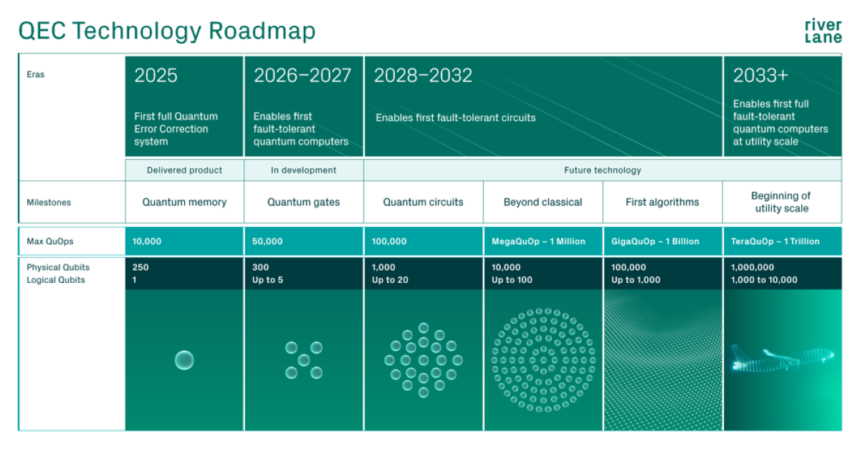
Riverlane’s roadmap defines successive generations of ‘fault-tolerant’ (e.g. error corrected) systems, each representing a 1,000x scale-up in the number of reliable quantum operations (‘QuOps’) the quantum computer can perform when using Riverlane’s error correction system.
With the roadmap, MegaQuOp systems (one million reliable operations), are expected before the end of the decade.
At this stage, quantum computers are expected to surpass classical supercomputers for a narrow set of specialised problems. Early hybrid systems combining quantum processors with AI and classical computing will begin tackling scientific challenges previously beyond reach, particularly in materials science and chemistry.
Also, GigaQuOp systems (one billion reliable operations), are expected by the early 2030s.
Representing a further 1,000× increase in computational capacity, GigaQuOp systems will support complex quantum algorithms and begin enabling a first wave of commercial quantum applications. At this scale, quantum computers will begin modelling complex molecular and physical systems with unprecedented fidelity, accelerating discovery in fields such as advanced materials, energy technologies and industrial chemistry.
In addition, TeraQuOp systems (one trillion reliable operations), are expected from 2033 onwards.
Reaching TeraQuOp scale marks the beginning of utility-scale quantum computing. At this stage, quantum systems are expected to deliver transformative advantages across multiple industries, including materials discovery, molecular chemistry, drug design and climate modelling.
The roadmap shows the evolution of Riverlane’s hardware and software products that enable this scaling.
Deltaflow, Riverlane’s real-time QEC system that sits as a layer within the quantum computing stack. Built on scalable FPGA hardware, Deltaflow works by encoding many physical qubits into a single logical qubit, then inferring and decoding errors across many such logical qubits while processing terabytes of data per second in real-time.
Deltakit , Riverlane’s open-source software development kit (SDK) that helps developers and researchers experiment with quantum error correction before deploying real-time QEC on quantum hardware.
Among quantum computing professionals, 95% believe QEC is essential for reaching utility-scale quantum computing. Yet the vast majority cite limited training, knowledge and access to QEC resources as barriers to adoption. Deltakit fills this gap.
Riverlane’s roadmap aligns with the ambitious timelines being explored by various national quantum programmes. Riverlane has partnerships with more than twenty quantum computer makers and national labs in Europe and the US covering all major qubit types, including several performers in DARPA’s Quantum Benchmarking Initiative.
“Each generation of quantum computers opens new areas for scientific exploration, with different qubit modalities taking researchers down many different paths,” said Neil Gillespie, VP of applied research at Riverlane.